Knob and Tube Removal and Rewiring in Puyallup, WA
Auburn Knob and Tube handles knob-and-tube removal and rewiring in Puyallup, WA: tracing which original circuits are still live, replacing them with grounded cable, swapping out fuse boxes and early panels, and phasing the work so you can stay in the house. Puyallup has one of the larger pools of pre-1950 homes near Auburn, so original wiring is a more realistic question there than in newer suburbs.
Census estimates count about 1,860 Puyallup homes built before 1950, roughly 11 percent of the city’s housing, with about 1,240 of them from before 1940. Most of the rest is newer: around three in five homes date from 1980 or later.
Knob and tube removal and rewiring options in Puyallup
Removing knob and tube from older Puyallup homes
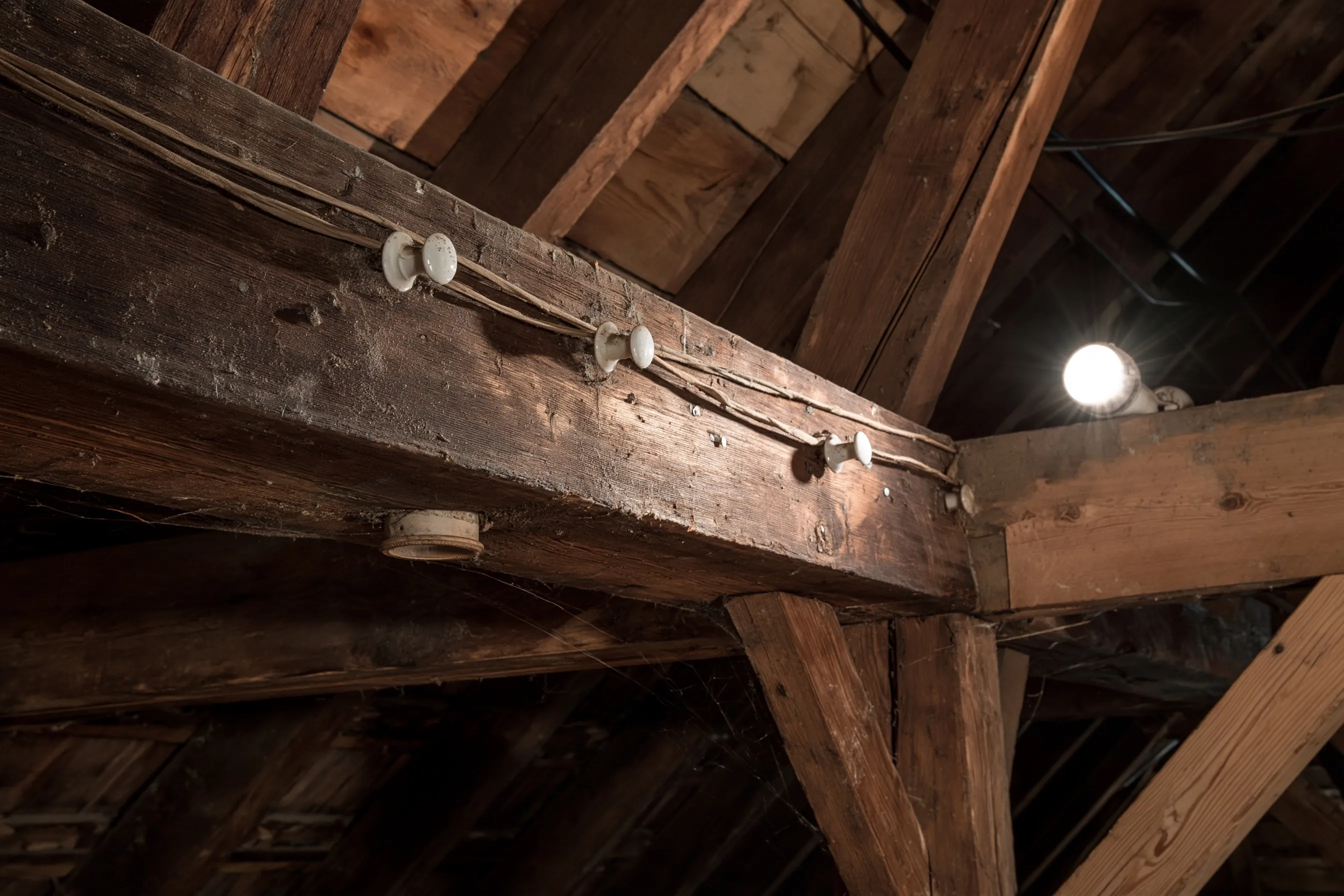
In a house from before about 1940, original wiring often still survives in the attic and the upstairs ceilings even where the lower floors were updated. We follow each run from the panel, separate live circuits from ones already cut off, and replace the live ones with grounded cable and new boxes. Runs that are confirmed dead can usually stay hidden in the walls; we note where they are. That approach is the same one described on our Auburn knob-and-tube homepage.
Fuse box and early panel replacement
Homes of that age may still have a plug-fuse box or an early breaker panel. Any knob-and-tube circuit kept for now needs protection sized to its wire, and if insulation is to go around it, Washington requires breaker or Type S protection at the lower 60°C rating; new grounded circuits also need panel space. That is why the box and the rewire are usually planned as one job; our page on fuse box replacement explains the equipment types.
Rewiring in phases
For a family that cannot move out, the rewire can be broken into planned stages, each inspected before walls or ceilings are closed. Phases follow circuits rather than room outlines, and each one ends with an updated circuit map. Our room-by-room rewiring page covers how the phases are chosen and what living in the house is like meanwhile.
Older homes in Puyallup
A valley town built on the 1880s hop boom
Puyallup’s townsite was platted in 1877, grew quickly on hop farming in the 1880s, and incorporated in 1890 with Ezra Meeker as its first mayor. His Italianate mansion from around 1890 is now a house museum run by the Puyallup Historical Society. Houses from the following decades, through the 1930s and 1940s, make up the older stock that is most likely to have had knob-and-tube installed originally.
Census year-built figures are estimates with margins of error, and a house’s age only suggests what is behind its walls. A Puyallup home from the 1920s may have been fully rewired in the 1960s; a 1940s house may still have original circuits upstairs. Tracing the wiring is the only way to know.
Pierce County addresses: L&I or Tacoma Power
Puyallup is not one of the Washington cities that run their own electrical program, so electrical permits and inspections for addresses inside the city go through L&I. The exception to watch is outside city limits. L&I lists Tacoma Power as its own permitting authority for the properties it serves, including parts of unincorporated Pierce County as far south as Roy.
Many homes with a Puyallup mailing address sit on unincorporated South Hill rather than in the city itself. For those, we check the specific address before applying for a permit, because the issuing office decides where the permit is bought and who inspects.
Planning a rewire in an older Puyallup house
Routes through attics, crawlspaces and plaster
Knob-and-tube was strung through open framing before the walls were plastered, so the cleanest way to replace it is usually from above and below: down from the attic into upstairs walls, and up from a crawlspace or basement into the main floor. Where neither route reaches, small openings at switch and outlet locations or along a ceiling line let new cable be fished through lath and plaster. Mapping those routes before work starts keeps the number of openings down and tells you where patching will be needed afterwards.
Circuits the original house never had
A house wired in the 1920s was laid out for lights and a few outlets, not for a dishwasher, microwave, washer and space heaters. Replacing the old runs one for one would repeat that layout. Most rewires therefore add dedicated grounded circuits where modern loads are, especially kitchen counters, the bathroom and the laundry, and spread general outlets more evenly. Those extra circuits are also what decides whether the existing panel has enough spaces.
Agree what removal and rewiring include
The word “removal” means different things to different people, so the scope should spell it out. For most owners it means every active knob-and-tube circuit is replaced and disconnected, while dead runs inside finished walls are left in place rather than torn out. If you want visible runs in an attic or basement physically taken down, say so; it is separate work.
Other items to settle in writing: whether the panel or fuse box changes; which rooms get new grounded circuits, such as kitchen counters, bathroom and laundry; who patches plaster openings; how the work is phased if the house stays occupied; and what paperwork you receive at the end, normally the inspected permit and a circuit list.
If an insurer or a buyer’s inspector raised the wiring, share their exact wording. Insurers set their own requirements and we found no published Washington standard, so their written question is what the scope should answer.
Frequently asked questions
Who issues electrical permits in Puyallup?
For addresses inside Puyallup city limits, Washington L&I issues electrical permits and performs inspections. Addresses outside the city, including some with Puyallup mailing addresses, should be checked individually, because properties served by Tacoma Power fall under its own program.
Is South Hill part of Puyallup?
Not for permits. South Hill is a large unincorporated area that uses Puyallup mailing addresses, so the city’s status does not automatically apply there. We confirm which office covers a South Hill address before work is scheduled.
Is knob and tube common in Puyallup?
It is a minority of homes, but a real one. About one in nine Puyallup homes predates 1950, the era when knob-and-tube was still installed or still in service, and many of those have been partly or fully rewired since.
What affects the cost of rewiring a Puyallup home?
Mainly the number of circuits being replaced, how easily the attic and crawlspace reach them, plaster or drywall walls, whether the panel changes, how many phases the work is split into, and patching afterwards. We price each house after tracing it rather than publishing ranges.
Can I add attic insulation over knob and tube in my Puyallup house?
Washington allows it only after a licensed electrical contractor surveys the wiring and certifies in writing to L&I that it is in good condition, with Class I insulation (a flame-spread rating of 25 or less), no foam, and proper fuse or breaker protection. Rewiring the attic circuits first is often simpler.
East of Auburn, the plateau town of Enumclaw has an even higher share of pre-1950 homes; see knob and tube removal in Enumclaw for how the work is planned there.
Your next step
Request knob and tube removal and rewiring in Puyallup, WA
Share the Puyallup address, roughly when the house was built and where you have seen knob-and-tube or a fuse box. If an inspection report or insurer letter mentions the wiring, describe what it says. We'll get back to you soon with an estimate or any questions we have. Estimates are free and there's no obligation.